
Water Under Vinyl Plank Flooring: Checking the Layers Below
Check for water beneath vinyl plank even when the surface looks intact, including pads, subfloors, contamination, and the conditions for reinstallation.
Know what to save, what to question,
and what to do next.

Sergej Lisetskij
Water Damage Restoration
Technician (WRT)
Sergej Lisetskij holds the Water Damage Restoration Technician (WRT) certification from the Institute of Inspection, Cleaning and Restoration Certification (IICRC).
This qualification demonstrates knowledge of water damage, restoration procedures and techniques for drying buildings.
WRT is an individual technician certification.
About the WRT certificationCheck for water beneath vinyl plank even when the surface looks intact, including pads, subfloors, contamination, and the conditions for reinstallation.
Review mitigation invoices against authorized work, quantities, service logs and agreed rates while keeping insurer allowances separate from contract obligations.
Fresh paint and recurring stains can justify questions without proving concealment. Preserve records and investigate the underlying moisture condition.
Determine drying completion from material-specific goals, consistent trends, hidden-layer checks, and a clear handoff before reconstruction conceals the evidence.
From the first wet patch to the final walkthrough, find the part you need to understand.
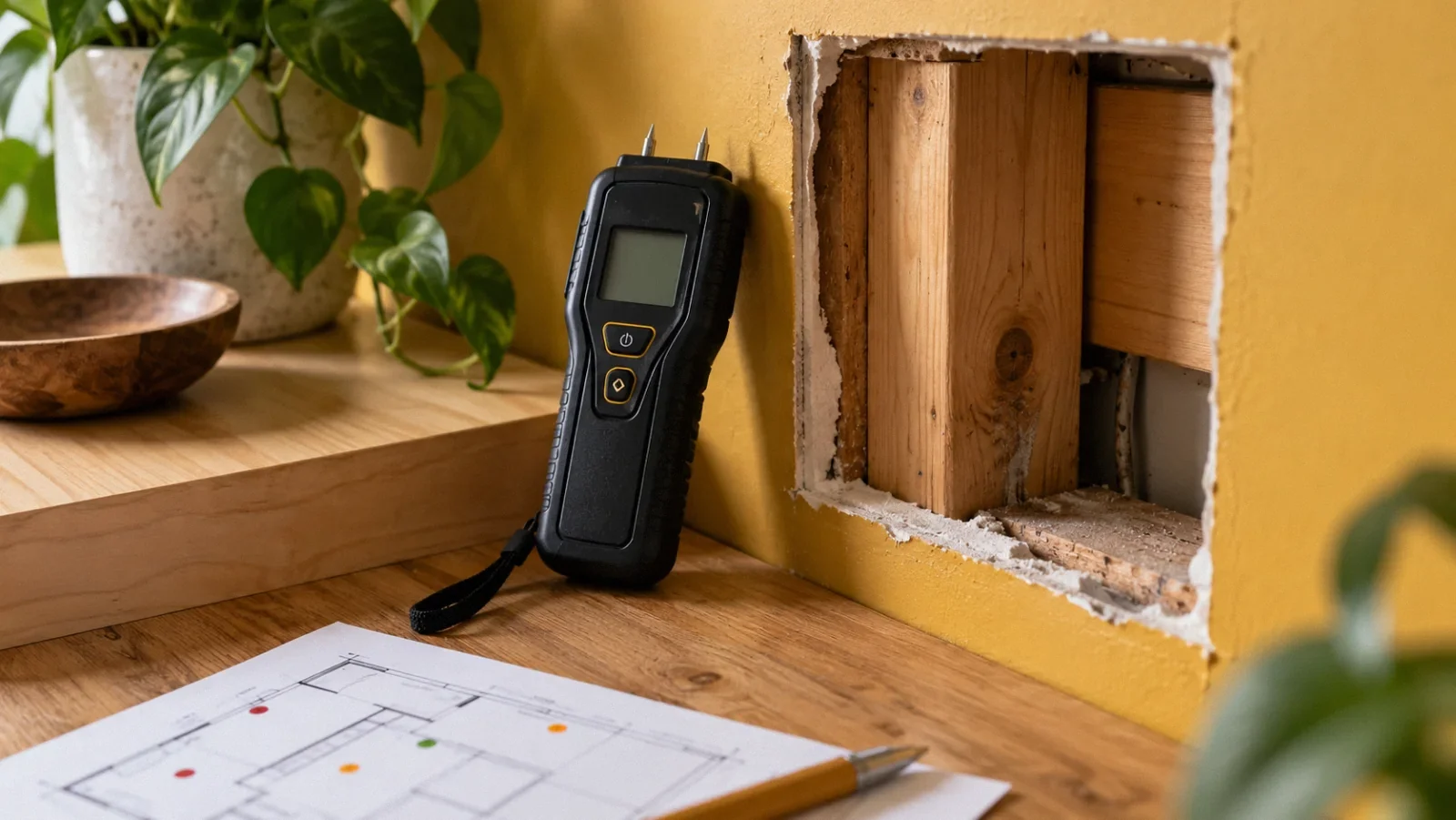
The most useful question is often not “How long will it take?” but “What evidence tells us it’s ready?”
Our guides connect the questions people ask with public guidance, the records worth keeping, and the decisions that still need a qualified professional.
How this guide is madeRecurring concerns from homeowner discussions, answered with context and sources.
All common questionsKeep clear of electrical and structural hazards, stop the water only if it is safe, and document the affected areas without delaying necessary emergency work. The order matters more than buying equipment.
Read the full guideSometimes, but a dry-looking surface is not enough. The water source, contamination, material condition and moisture in the layers below determine whether drying in place is reasonable.
Read the full guideAsk for a moisture map, repeat readings at identified locations, a stated drying goal and checks of concealed layers. A low room-humidity reading alone does not establish that materials are ready to cover.
Read the full guideThey do different jobs. Air movement helps evaporation; dehumidification removes water vapor. Equipment choice also depends on access, conditions and contamination. A fixed machine count is not a drying plan.
Read the full guideColor cannot establish mold species, exposure or a medical diagnosis. Address the moisture and affected materials, and discuss individual health concerns with a clinician. Do not rely on appearance alone.
Read the full guideCoverage depends on the cause, policy exclusions, endorsements and facts. Plumbing losses, repeated seepage, sewer backup and surface flooding can be treated differently. Get the coverage position in writing.
Read the full guideCompare the authorized scope, itemized labor and materials, equipment locations and dates, drying records and written change orders. An insurance estimate is not automatically the amount you owe under a separate contract.
Read the full guideIt can be a reason to ask questions, but it is not proof of fraud. Compare disclosures, repair records, stains, odors and moisture findings; preserve evidence before repairs change the condition.
Read the full guideNo. They answer different questions. Permit inspections assess specified code work; a remediation assessment follows a defined moisture and cleanup scope. Neither should be described as a universal mold-free guarantee.
Read the full guideThe visible stain may be far from the entry point. Trace the pattern, weather or fixture use, and previous repairs before another cosmetic patch. Verification should test whether the source was actually corrected.
Read the full guidePublic guidance from environmental, public-health, emergency-management and consumer-protection agencies. Always check the scope and your local requirements.
Explore public resources

